

Editing and Translating Philoponus
Science in Print
Editing and Translating Philoponus in the Renaissance
Tommaso De Robertis
10 March 2026 – 5 PM (CET)
The reception and transmission of John Philoponus’s work constitute a remarkable chapter in the history of Aristotelian exegesis and its Renaissance revival. Long known only through indirect quotations and Arabic intermediaries, Philoponus’s radical critique of Aristotelian natural philosophy entered the Latin world piecemeal and belatedly.
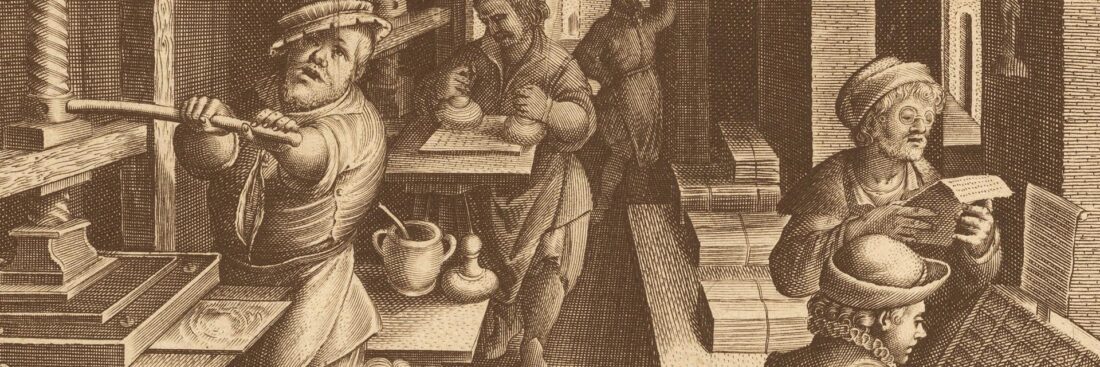
It was only in the fifteenth century, with the recovery of Greek manuscripts by Italian humanists and Byzantine émigrés, that European scholars could engage directly with his work. The subsequent decades witnessed not only the edition and dissemination of the Greek text, but also its transformation through printing and translation – processes that redefined Philoponus’s position within the intellectual landscape of early modern Europe.
Focusing on his commentary on Aristotle’s Physics, this lecture will examine both the recovery of the Greek text and its later diffusion through Latin translation, tracing the material and intellectual pathways that brought Philoponus’s commentary from the lands of Byzantium to Florence, Venice, and beyond.
This lecture will first reconstruct the manuscript tradition, surveying the principal codices, their provenance, and the networks of scholars and collectors responsible for their recovery and circulation.
It will then explore the two sixteenth-century Latin translations of the work, produced, respectively, by Guglielmo Doroteo (1539) and Giovanni Battista Rasario (1558). In doing so, it highlights the complex interplay between philological accuracy, editorial ambition, and scholarly forgery that characterised the humanist engagement with Philoponus’s work.
About the Speaker ...
Tommaso De Robertis is a Marie Skłodowska-Curie Postdoctoral Global Fellow at the University of Toronto and the University of Macerata, and a contract lecturer at the University of Macerata.
His work focuses on the fifteenth and sixteenth centuries, and Tommaso has held research positions at institutions including the University of Warwick, the Herzog August Bibliothek in Wolfenbüttel, and the University of Toronto. He is the co-author, with Valérie Cordonier, of Chrysostomus Javelli’s Epitome of Aristotle’s “Liber de bona fortuna” (Brill, 2021), and the co-editor, with Luca Burzelli, of Chrysostomus Javelli: Pagan Philosophy and Christian Thought in the Renaissance (Springer, 2023). His work has appeared in Annals of Science, and he serves on the editorial boards of the Journals Bruniana & Campanelliana and Mediterranea.