
Orbs of Blood in 14th-Century Persia
Orbs of Blood
in 14th-Century Persia
The «Tānksūqnāmah» and Its Theory of the Rotational Motion of Blood
Ben Kavoussi
28 May 2026 – 5 PM (CEST)
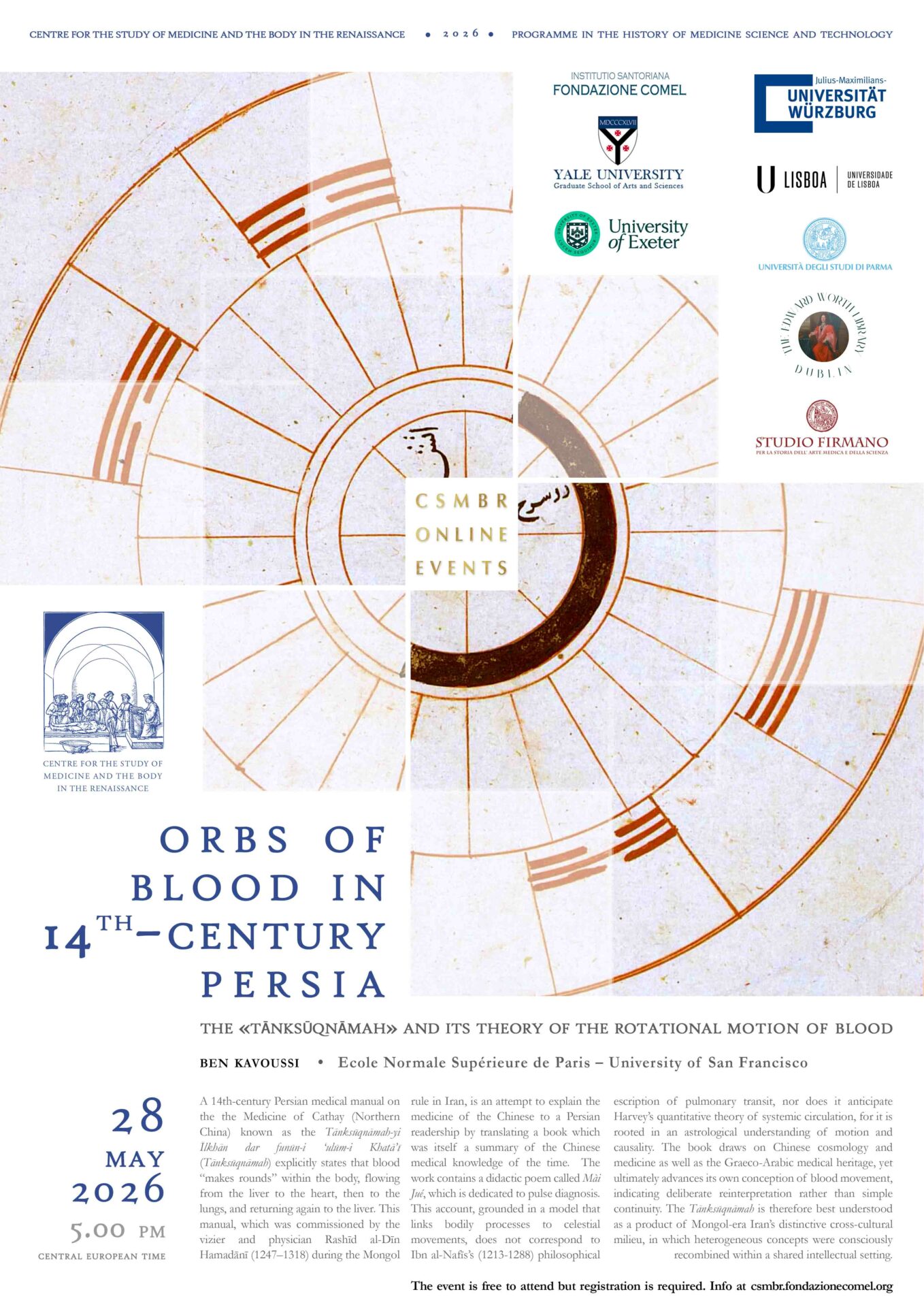
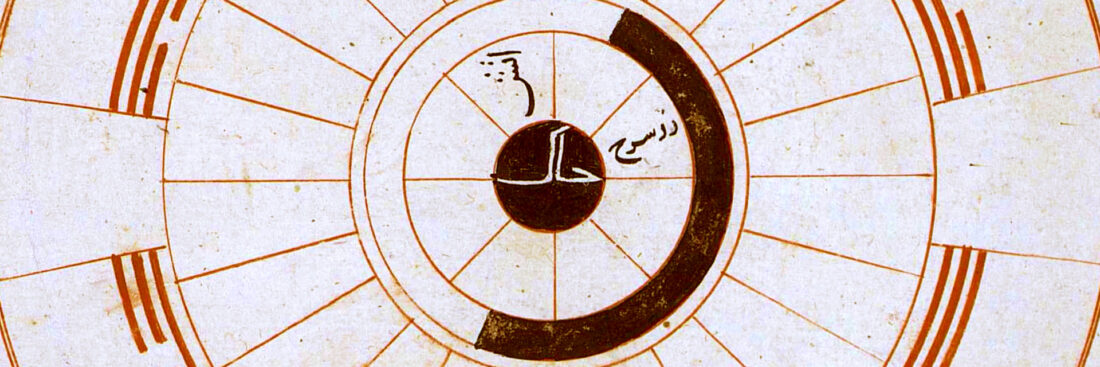
A 14th-century Persian medical manual on the Medicine of Cathay (Northern China) known as the Tānksūqnāmah-yi Īlkhān dar funūn-i ʿulūm-i Khaṭāʾī (Tānksūqnāmah) explicitly states that blood “makes rounds” within the body, flowing from the liver to the heart, then to the lungs, and returning again to the liver.
This manual, which was commissioned by the vizier and physician Rashīd al-Dīn Hamadānī (1247–1318) during the Mongol rule in Iran, is an attempt to explain the medicine of the Chinese to a Persian readership by translating a book which was itself a summary of the Chinese medical knowledge of the time. The work contains a didactic poem called Mài Jué, which is dedicated to pulse diagnosis.
This account, grounded in a model that links bodily processes to celestial movements, does not correspond to Ibn al-Nafīs’s (1213–1288) philosophical description of pulmonary transit, nor does it anticipate William Harvey’s (1578–1657) quantitative theory of systemic circulation, for it is rooted in an astrological understanding of motion and causality.
The book draws on Chinese cosmology and medicine as well as the Graeco-Arabic medical heritage, yet ultimately advances its own conception of blood movement, indicating deliberate reinterpretation rather than simple continuity.
The Tānksūqnāmah is therefore best understood as a product of Mongol-era Iran’s distinctive cross-cultural milieu, in which heterogeneous concepts were consciously recombined within a shared intellectual setting.
Seen in this light, the text exemplifies how scientific ideas could emerge through reinterpretation within cultural and scientific contact zones rather than through linear transmission within a single lineage.
About the Speaker ...
Ben Kavoussi holds a PhD in Epistemology, History of Science and Technology from the École Normale Supérieure and a Doctor of Medical Science.
He has over a decade of clinical experience as a Physician Assistant in emergency medicine, neurosurgery, pain management, and refugee health. His research focuses on cross-cultural medical traditions, with particular attention to Persian and Chinese medicine in the Mongol period, the history of blood movement, and the historiography of acupuncture. He is currently developing book projects on the Tānksūqnāmah of Rashīd al-Dīn and on the transmission of medical and cosmological ideas across Eurasia. His publications include a study on the rotational flow of blood in a fourteenth-century Persian manuscript and several critical contributions to the history and evaluation of acupuncture.