

The Brain in the Islamicate Tradition
Between Text and Image
Diagrams of the (Ventricles of the) Brain in the Medieval
Islamicate Tradition
Shahrzad Irannejad
19 February 2026 – 5 PM (CET)
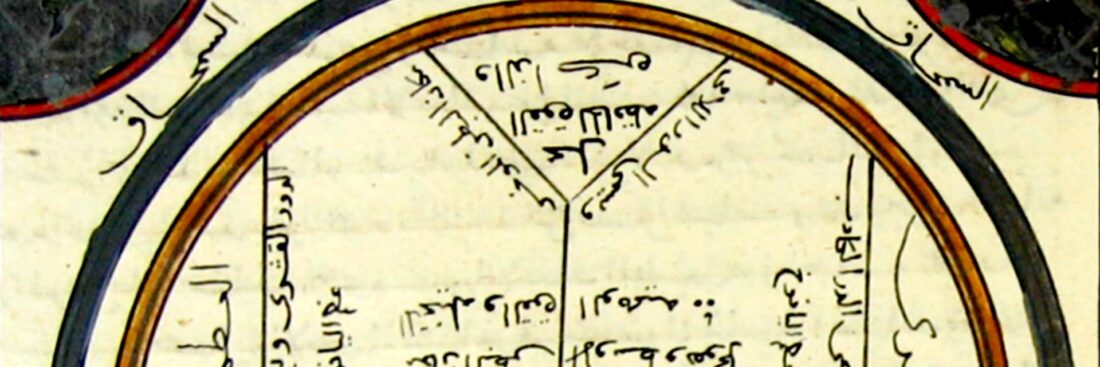
In this lecture, I will discuss the very few, yet thought-provoking, visual representations of the brain and its ventricles in the medieval Islamicate tradition. Some illustrations of the brain show up in the Avicennan tradition, while numerous mini diagrams of the ventricles of the brain show up in the Kitāb al-Manṣūrī fi al-Ṭibb by al-Rāzī (865–925 CE) — a concise yet comprehensive and influential encyclopedia of medicine.
In several manuscript witnesses of this work numerous anatomical diagrams can be seen of the ventricles of the brain. These diagrams were not necessarily meant to copy reality or precise anatomy, and were most probably executed by the scribe/copyist of the text.
What is particularly intriguing is the variation in the visual representation of these anatomical structures. In other words, these diagrams qua “imagetexts” were subject to mouvance, i.e. accidental or deliberate changes, just like the text that was hand-copied from one manuscript to the other.
I argue that certain philological questions can be posed to these diagrams; for instance, questions pertaining to the familial relationship of the manuscript witnesses.
At the intersection of codicology and philology, I explore the usefulness of the family tree metaphor (stemma codicum) in establishing the relationship of various manuscripts based on the visual affinities of their respective diagrams.
I ask to what extent the establishment of anatomical truth and reconstructing the archetype needs to be the focus, versus the exploration of the dynamism of visual representation as a result of scribal practices across time and space.
About the Speaker ...
Shahrzad Irannejad is a post-doctoral fellow at the newly-established Avicenna Study Center at Ruhr University Bochum.
She is a researcher in the history of medicine in the medieval Islamicate tradition with a special focus on Avicenna. In her PhD project “Localization of the Avicennan inner senses in the Galenic Brain” she investigated how, in an intersection of medicine and philosophy, concepts (of the brain and the soul) were transformed as they travelled beyond linguistic and cultural borders from the Greek tradition to the medieval Arabic tradition. In looking into the mechanics of textual transfer of knowledge in the medieval Islamicate world, she is also keen on engaging with the codicological aspects of the material media of knowledge transfer. She has published articles and book chapters on the history of concepts (of the soul and the body) and entanglements of medicine and cuisine.