

Healing Like a Medieval Woman
FORMA FLUENS
Histories of the Microcosm
Healing like a Medieval Woman
The Wisdom of Hildegard von Bingen
Giulia Guidara
Independent Scholar
For most of the Middle Ages, medicine was practiced by both men and women. It was only from the thirteenth century onward that medicine became an exclusively male profession. A series of decrees and measures issued by ecclesiastical and secular authorities prohibited anyone who had not completed university studies from working as a physician; this effectively barred women from the lawful practice of medicine, since access to universities was denied to them. After the thirteenth century, women could nevertheless continue to engage in medical practice as pharmacists, surgeons, or barber-surgeons under male supervision—often that of a husband or father. Women who worked without male oversight were subject to sanctions or, worse, accused of witchcraft.[1]
A significant written testimony to the presence of women physicians in the Middle Ages—as well as to the medical knowledge of the period—consists of Hildegard of Bingen’s (1098–1179) medical writings, Physica and Cause et Cure. While neither work is a strictly medical text—they also contain extensive cosmological discussions and, particularly in the Physica, detailed descriptions of natural entities—they are nonetheless texts in which medicine occupies a central role. Cause et Cure addresses disorders and their remedies in depth, as its title indicates, whereas the Physica outlines, for each natural object considered—plants, stones, animals, and metals—their medicinal applications.
Though now treated as separate works, the two texts were originally closely interconnected. It is likely that Hildegard and her secretary, Volmar, worked on a single text concerning the natural world, Liber subtilitatum diversarum naturarum creaturarum, leaving half of each parchment blank for subsequent additions of varying length. The frequency of these additions soon led readers to perceive the two columns as separate texts, each identified by a different title. The supplementary text became the Liber compositae medicinae, from which Cause et Cure is derived (in its current form, it also includes additions by other anonymous authors), while the foundational text, titled Liber simplicis medicinae, gave rise to the Physica.[2]
Hildegard’s medical knowledge derives from a variety of sources. A primary role was undoubtedly played by her direct experience in the infirmaries of Disibodenberg and Rupertsberg, where she worked from a young age.[3] Her texts, however, also reveal a solid theoretical education: Hildegard made extensive use of the Summarium Heinrici, an eleventh-century Latin encyclopedic compendium used as a teaching text in monastic schools throughout the Germanic region, as well as of medical works from the libraries of Rupertsberg and the Abbey of Trier.[4]
The cosmological sections of the Physica and Cause et Cure articulate the spiritual foundation of Hildegard’s medicine: the intrinsic affinity among all of God’s creatures. In the Praefatio to Book I of the Physica, the fibrous tissues of trees are likened to the veins of the human body, stones to bones and nails, the moisture of stones to bone marrow, and herbs to hair (if fine and easily digestible), to sweat (if dry and heavy for digestion), or to excretions (if poisonous).[5] Furthermore, Book I of Cause et Cure explains that the four elements constituting the cosmos—air, water, earth and fire—are the same as those that compose the human being and make vital functions possible.[6] This close connection between the cosmos and the human body means that the body can be influenced, and thus healed, by natural entities.
On this spiritual framework, Hildegard builds a body of medical knowledge. At its foundation lies the theory of the four humors: Cause et Cure mentions humidum (moist), siccum (dry), tepidum (warm), and spuma or spumaticum (foam), and explains that they derive from the action of the four elements on the human body. Siccum arises from the action of fire on the organism, humidum derives from that of air and its moisture, spuma forms as a result of water acting through the blood, and tepidum is related to the action of earth, through the flesh. All four humors are present in the human organism, though in varying proportions depending on the individual. In Hildegard, however, the theory of the four humors does not lead to a systematic typology of human character, as sometimes occurs in other authors. Indeed, in the second book of Cause et Cure, four types of men and four types of women are described, and the specific traits of each type are linked to gender and physical characteristics—such as the amount of blood and flesh, the size of the bones in women, and the appearance of the brain, face, and veins in men—but not to specific proportions of humidum, siccum, tepidum, and spuma/spumaticum.[7]
In Cause et Cure, Hildegard identifies the causes of a great many disorders. All diseases share a common origin: original sin, which introduced corruption into the human body. The forbidden fruit poisoned Adam’s body, rendering his flesh ulcerated and pierced. These ulcers and perforations generate turbulence and moisture of vapor within humans, from which phlegm arises and coagulates, bringing various illnesses upon the human body.[8]

Giulia Guidara is a high school teacher and independent researcher. Her research focuses on astrology and free will in the Middle Ages. She is the author of Prima di Platone. Plotino e gli inizi della filosofia greca (Pisa, 2021), which examines how Plotinus uses the Presocratics to give legitimacy and authority to his philosophical theories. Guidara received her BA in philosophy at the University of Pisa and her PhD in Humanities from the University of Trento. She held research fellowships at the University of Fribourg (Suisse), at the University of Pisa and at the Giunta Centrale per gli Studi Storici (Rome).
In addition to this common cause—both spiritual and physical—Hildegard also attributes diseases to more specific factors. Many pathologies arise from an imbalance among humidum, siccum, tepidum, and spuma/spumaticum within the organism.
A considerable number of illnesses are linked to melancholy, described as a boiling of the veins that primarily affects the brain and heart and contracts a person’s veins, blood, and flesh; in some cases, however, melancholy may itself be the consequence of other disorders. Certain diseases are attributed to the point in the lunar calendar at which an individual was conceived: Cause et Cure concludes with a long and detailed lunarium, notable for its originality compared with contemporary German, Latin, and Arabic examples.[9] Finally, some disorders are attributed to mental overload. In this case, however, the disturbances affect only the cognitive or emotional sphere, whereas the other causes outlined above can give rise to mental illnesses, physical illnesses, or both.[10]
Hildegard always explains the ratio behind the remedies she proposes. In Cause et Cure, the ratio is closely linked to the description of the disease itself. Hildegard details the effects of a disorder on the body and, at the same time, provides the remedy that counterbalances them, with the aim of restoring the equilibrium disrupted by the pathology. In the Physica, by contrast, therapeutic indications are embedded within the descriptions of plants, animals, stones, and metals, appearing as the logical consequences of their main properties. Thus, in Hildegard’s writings, remedies do not appear mysterious or arbitrary; they are grounded in a thorough understanding of disease, the human body, and the natural world, which Hildegard shares with her readers.
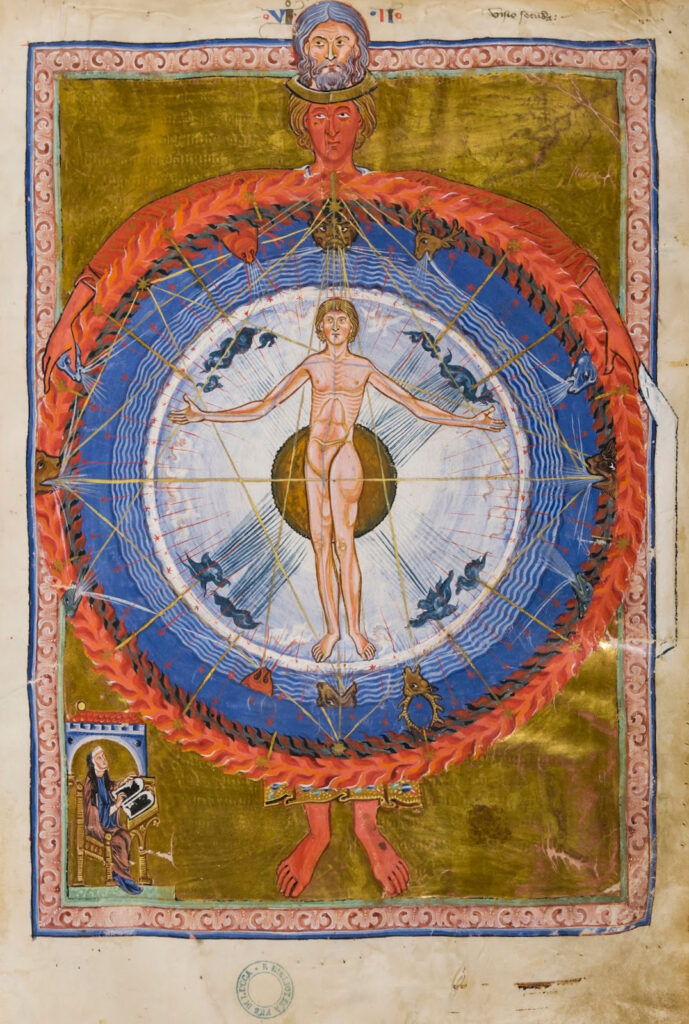
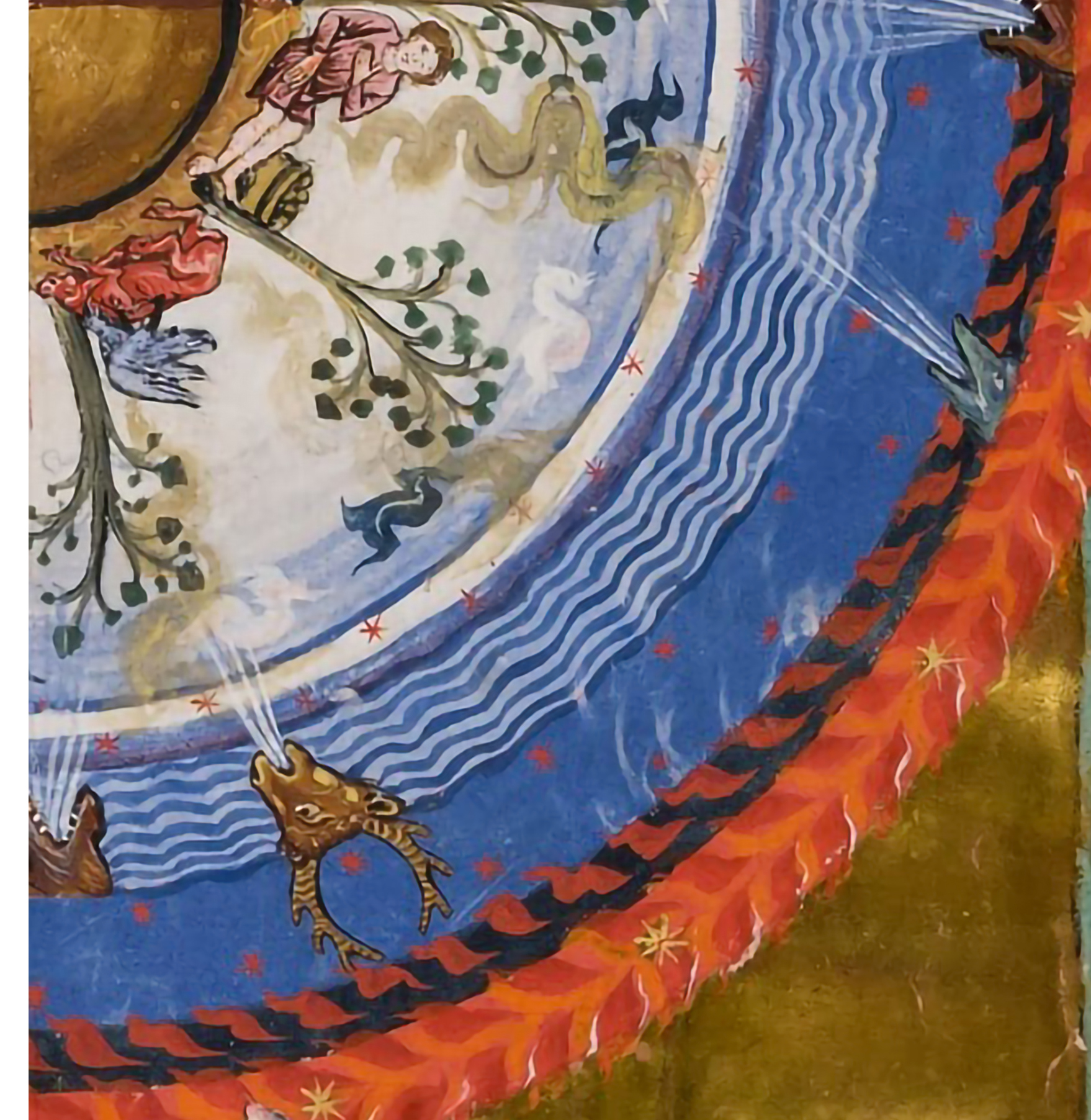
Figure 1. Astrological Man. From Hildegard von Bingen’s Liber divinorum operum. MS 1492, f. 9r. Courtesy of the Biblioteca Statale, Lucca
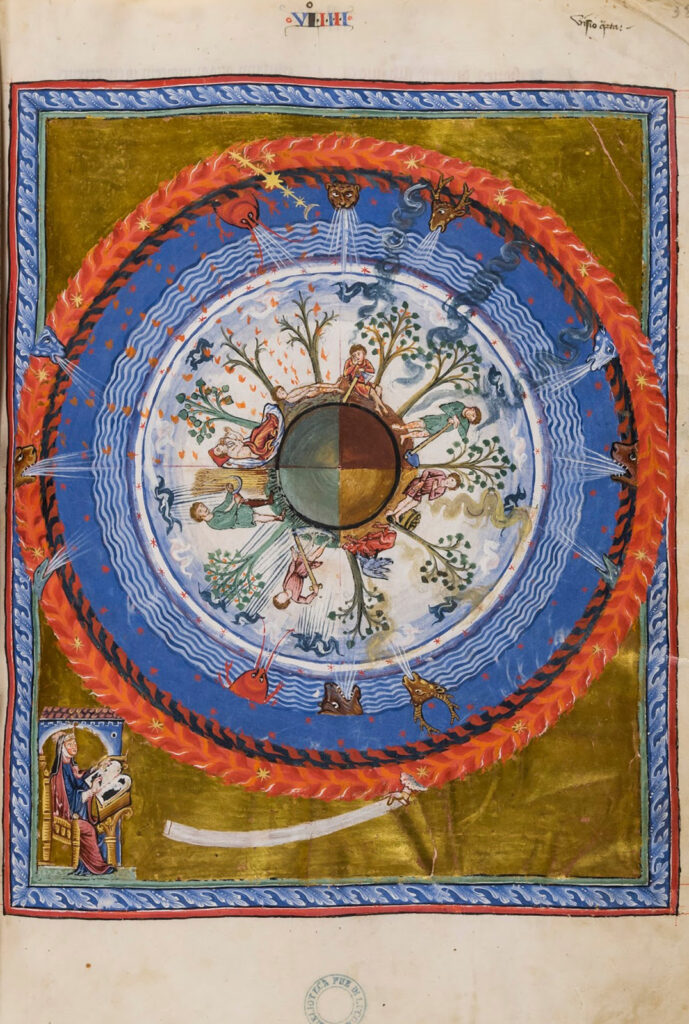
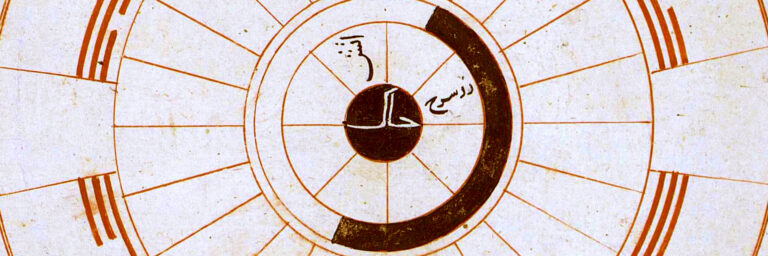
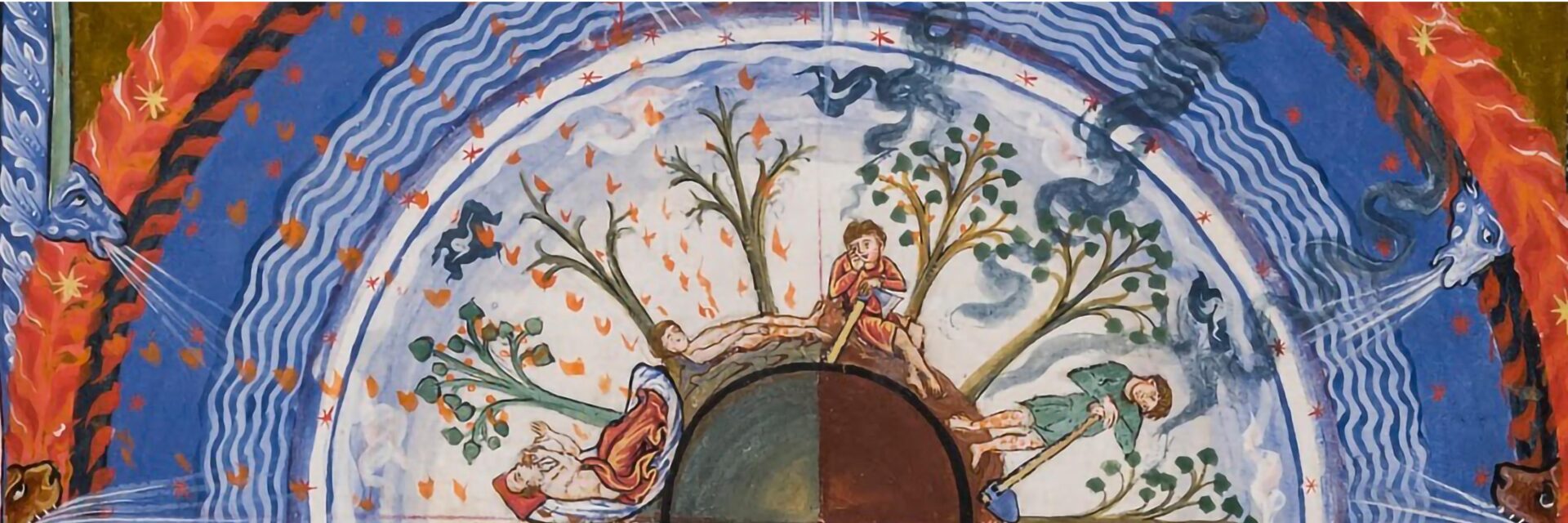
Figure 2. The influence of the elements and stars on the ages of man. From Hildegard von Bingen’s Liber divinorum operum, f. 38r. Courtesy of the Biblioteca Statale, Lucca
Medicine is thus a human knowledge, in the sense that it is comprehensible to humans and practiced by humans for the benefit of other humans. Yet medicine also has a divine dimension, and this aspect emerges clearly in Cause et Cure. The second and third books contain the same Latin formula toward the end (the second book concludes with it, whereas the third book includes it about eighteen lines before the end): “De predictis infirmitatibus subscripte medicina a deo demonstrate aut hominem liberabunt aut ipse morietur aut deus eum liberari non uult” (“Concerning the aforesaid illnesses, the medicines prescribed below—revealed by God—will either cure the man, or he will die, or God does not will that he be cured”).
This formula attributes to God both the therapeutic instructions and their outcomes. Consequently, the medical research and practice entrusted to the text are guided by God, who is the ultimate—and true—responsible agent for all the good that humans accomplish. Even the course of a disease is under divine guidance: the healing or death of an individual depends, in fact, not on the physician, but on the will of God.