

Mobility in European Medicine
FORMA FLUENS
Histories of the Microcosm
Geographical Mobility in
Early Modern European Medicine
Pere d’Olesa (c. 1460–1531) through
Three Other Spanish 'Peregrini'
Álvaro Basols Berges
Autonomous University of Barcelona
Comèl Grant
Book merchants seeking favourable deals, printers prospecting for clients, practitioners aiming to get promotion, academics pursuing distinction… Indeed, any discussion of knowledge and its circulation is, in essence, a travel account. The peregrinationes described here are but a few among the many trajectories that at the dawn of scientific printing shaped the intellectual world together with its diverse actors and objects.
To outline those Spanish physicians who sought their fortune abroad, I will focus on the Majorcan physician Pere d’Olesa (c. 1460–1531), comparing his background and his stay in Pisa with the cases of Gaspar Torrella (c. 1452– c. 1520), Francesc Argilagues (fl. c. 1470–1508) and Andrés Laguna (c. 1510–1559). We may begin by examining how Gaspar d’Olesa — eldest son of Pere and editor of his unique posthumous work — recounts his father’s journey:
Aristotle’s sweet-honeyed milk nourished the great Pere d’Olesa. This was especially true in Italy, at the Studio Fiorentino in Pisa, the university where he studied under the guidance of Oliviero Arduini [fl. 1491/92] and Lorenzo Lorenzi [c. 1459/60–1502], Florentine men of no small erudition. In medicine, he was taught by Luchino Gerla [† post 1506], a man eminent in calculus and in medicine both theoretical and practical. During this time, between 1490 and 1495, he was also educated by Bernardo Torni [1452–1497], Cristoforo/Cristofano d’Arezzo [fl. 1471–1501], and Buoninsegna di Bartolomeo Buoninsegni [fl. 1485–1503]. In 1495, on the occasion of the army invasion of Italy by King Charles VIII of France [1494–1495], d’Olesa moved first to Montpellier, and then, because of the French wars in Spain, to Lleida, where he appears to have finished his medical studies. In 1517, he moved to the city of Valencia, where he remained until his death in 1531. [1]
This valuable information about Pere d’Olesa’s life is available thanks to the first of the two nuncupatory epistles that his son Gaspar included in the Summa totius philosophie et medicine (Valencia, Durand Salvagnac and Arnau Guillem de Montpesat, 1536) [Figure 1], a compendium divided into three treatises that Pere wrote in the city of Valencia or its surroundings between July 1527 and September 1531. Traditionally classified as an early expression of corpuscularism, this work — which offers an elaboration of Avicenna’s Canon and twenty-one quaestiones on medicine and natural philosophy — was completed and published by Francesc Pujades, a disciple of the author, in 1532. Once Gaspar d’Olesa had reviewed the material and financed its two main parts, the volume was printed in Valencia in 1536.
Returning to the First Epistle, in addition to offering an overview of our protagonist’s geographical path [Figure 2], it highlights our first key point: university relations. After reviewing the academic records from the Pisan Studium, we can confirm Olesa’s presence at the institution between 1491–92 and 1493–94.[2] On 8 July 1494, the Studium approved a payment of 20 Florentine lire to Olesa for participating in the lectiones festivae for the upcoming term. However, “the storms of war throughout Italy and the passage of the French in their campaign to recover the kingdom of Apulia [sic]” brought the planned lectures to a halt [Figure 3]. [3] On 26 November 1495, the Consiglio dell’Università, incidentally based in Prato, appointed a substitute for Olesa, “who did not return to the Studium”.[4]
Once d’Olesa has been outlined, let us turn to some considerations concerning the overarching theme:
We have already referred to the motives behind scholars’ geographical mobility. Although varied reasons for these peregrinationes can be inferred, what truly underlies this phenomenon in each individual case remains a mystery. Yet, the decision to pursue studies in the city of Pisa is far from obscure: it can be readily understood in light of the significant renewal that Lorenzo il Magnifico, the ruler of the Florentine Republic, introduced at the Studio which was reopened in 1470.[5]
Among the many members of the university community attracted by this important event, the case of Francesc Argilagues stands out. It is very likely that this Valencian medical student moved from Siena to Pisa following Alessandro Sermoneta, one of his teachers there (1424–1487). Moreover, after getting his doctorate in arts and medicine in 1477, Argilagues appears to have accompanied Sermoneta to Padua, where he was appointed as ordinary lecturer in theoretical medicine in 1479 [6]. Unfortunately, the current limitations of our research preclude us from delving into Olesa’s masters [Figure 4] and their possible relations with him.
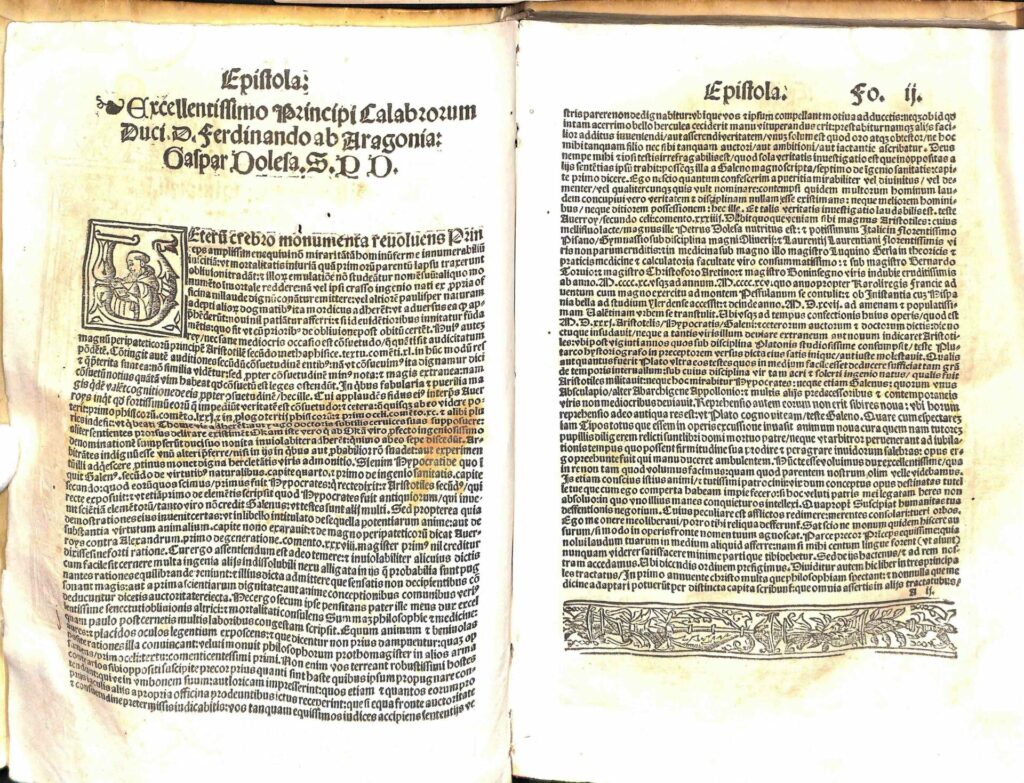
Figure 1. Summa totius philosophie et medicine. First Epistle. Biblioteca “Can Sales”, Palma de Mallorca, Spain.
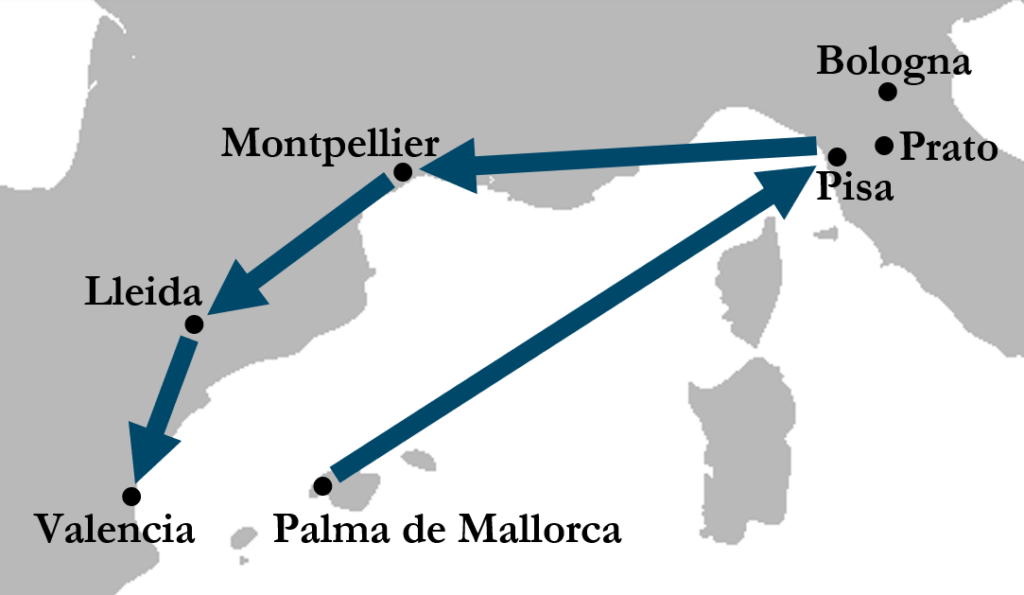
Figure 2. Pere d’Olesa’s path before permanently settling in Valencia and its surroundings. Author’s elaboration.

Figure 3. Granacci’s Entry of Charles VIII into Florence (17 November 1494), c. 1518, Galleria degli Uffizi.
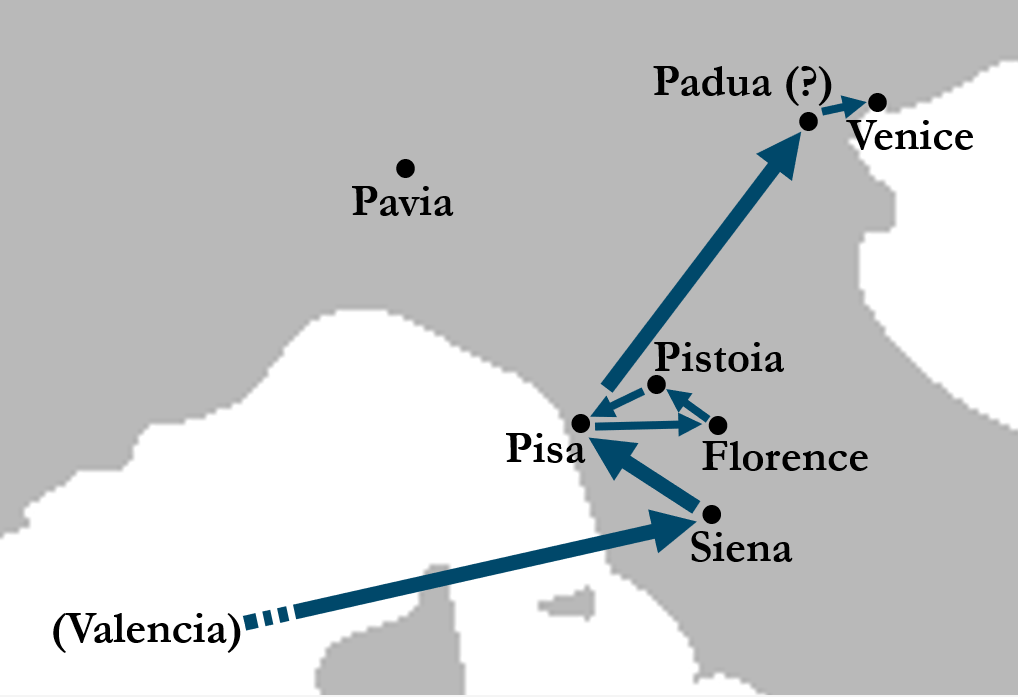
Figure 4. Francesc Argilagues’ path until his trace is lost. Author’s elaboration.
Our second key point concerns family. Alongside his brother Jerónimo, another Valencian scholar, Gaspar Torrella, followed Sermoneta from Siena to Pisa [Figure 5]. We consider it plausible that their father, maestro Ferrer Torrella, an alumnus of the University of Montpellier, was behind this remarkable display of resources, not only in financial terms, but also in their determination to undertake such a journey. Of his third son, we only know that he practised medicine in Cagliari [7].
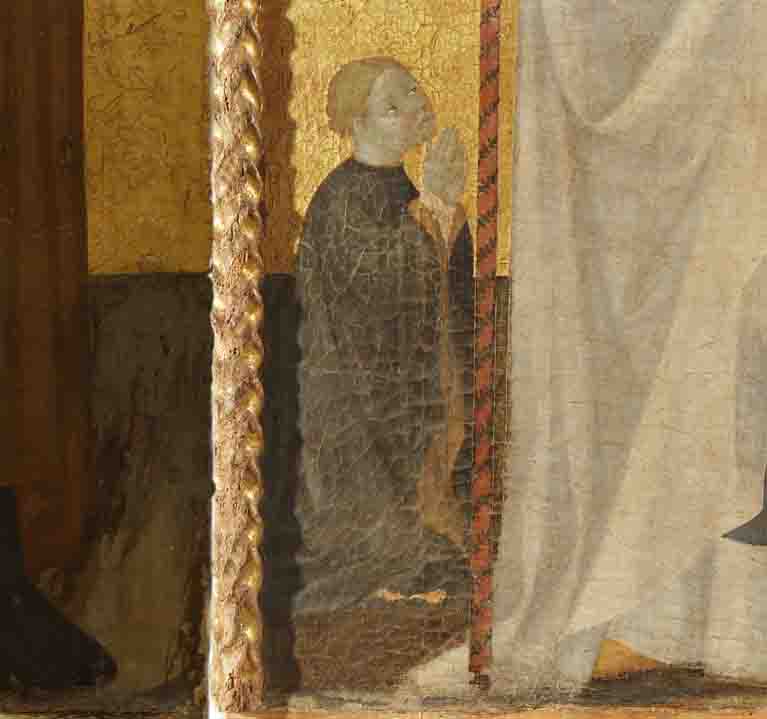
As for the Olesa family, even though they were in no way associated with medicine, the case of Bernat d’Olesa (ca. 1370–ca. 1433) [Figure 6], Pere’s ancestor, is remarkable: after earning his doctorate in law at Bologna, he returned to Majorca, where his professional prestige, fruit of an exceptional education, soon translated into a handsome income.
Álvaro Basols Berges is a PhD student at the Institut d’Història de la Ciència at the Autonomous University of Barcelona (IHC-UAB). Combining intellectual history with the history of the book, his doctoral project examines the Summa totius philosophie et medicine (1536), a compendium of three treatises that brings together the written legacy of Pere d’Olesa (c. 1460–1531), a renowned professor at the University of Valencia who studied in Pisa, Montpellier, and Lleida and practised medicine. By examining its references, contents, and circulation, the Summa sheds light on the academic curricula associated with its author and offers a case study for scholarly debates on humanism and corpuscularism.
From pawning books to making a living, he eventually held the highest magistratura in Palma — a political office that thereafter became customary among the Olesas [8].
When embarking on the peregrinatio academica, the chance for social mobility was certainly a significant inducement. For his part, after his formative stage, Pere d’Olesa secured an academic chair at the newly founded Estudi General in Valencia. There, he also served as promotor and examinador de metges: master of ceremonies and medical examiner in the city.
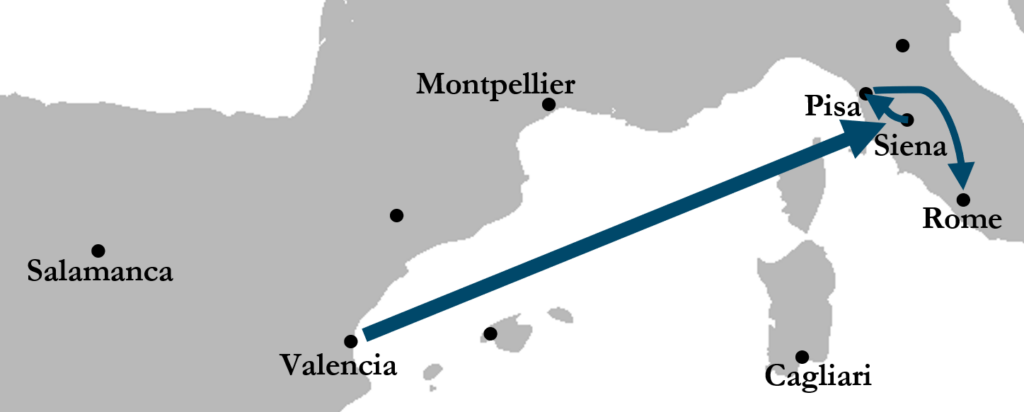
↑ Figure 5. Gaspar Torrella’s path before permanently settling in Rome. Author’s elaboration.
→ Figure 6. Bernat d’Olesa(?) praying. Detail of Retaule de Sant Bernat, Sant Antoni i Sant Nicolau, c. 1400. Museu de Mallorca.
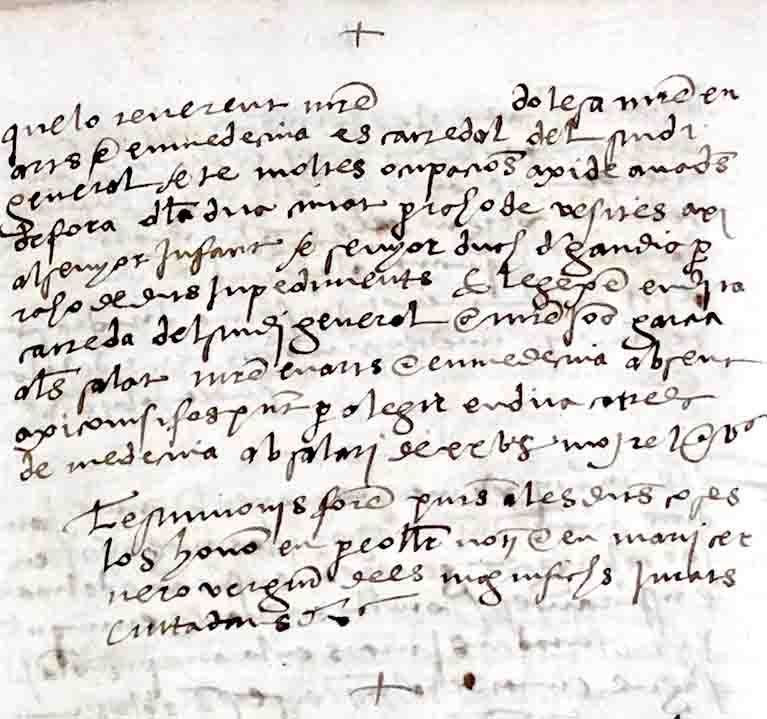
↑ Figure 7. Manuals de Consells, A 56, fol. 142r. Arxiu Històric Municipal de Valencia.
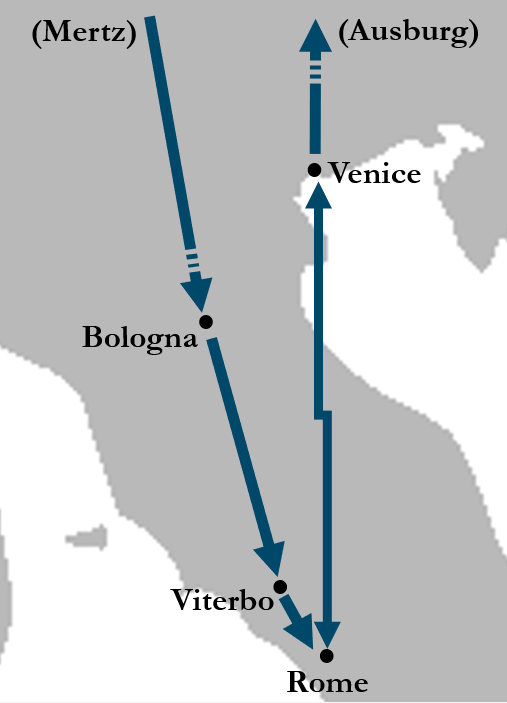
→ Figure 8. Andres Laguna’s path in Italy (1545–1554). Author’s elaboration.
Let us now focus on Pere d’Olesa’s life through the Valencian university records. On 14 November 1514 [Figure 7]:
The reverend mestre <Pere> d’Olesa, Master of Arts and Medicine, holds a chair in the Estudi General and has many occupations that include journeys outside [Valencia] for the purpose of visits to the Lord Infant and the Lord Duke of Gandia. Because of these obligations, he delegates his chair [9].
Therefore, the last domain I will consider here is the courtly one. The situation described in this note was not unusual at all: it is to be expected that the health demands of the aristocracy required access to the most distinguished physicians from the vicinity. In addition to the two nobles mentioned here — the Duke Juan de Borja Enríquez de Luna (1494–1543) and, probably, Enrique de Aragón y Pimentel (1445–1522); the so-called Infante Fortuna — we know that Pere d’Olesa treated other personalities, including a son of Jeroni Vich i Vallterra (1459–1534) [10], the ambassador in Rome between 1507 and 1517.
In that same city, Gaspar Torrella served as archiater – which means chief of medicine – to Pope Alexander VI (1492–1503), another Borgia. His survival of the purge that the new Pope Julius II (1503–1513) carried out against Alexander VI’s associates gives us an idea of his position and how highly his work must have been valued [11].
Expanding on the topic of the court physician, the Segovian Andrés Laguna (1510–1559) is an indispensable reference. Having journeyed through half of Europe, his time in Italy [Figure 8] — where he also obtained his doctorate in medicine in Bologna (1545) — is a remarkable example of other, less visible forms of influence. Beyond his medical services to Paul II (1534–1549) and Julius III (1550–1555), Laguna’s relations with the Ecclesia Viterbiensis and with Italian Iberian exponents like the Cardinal Francisco de Mendoza y Bobadilla and the imperial ambassador Francisco Vargas, who even advised him not to journey to the East [12], prompt many questions about Olesa that, at least for now, remain unanswered.
We shouldn’t end these considerations without a brief note on the history of the books. Powers like those cited had a major effect on writing and publishing, a determinant factor for many mobilities as well as for our tracking of the different historical elements: Torrella’s Consilium de modorrilla disease had a printing in Salamanca (1505), Argilagues’ manuscript [13] gives us his footprints, Laguna’s life cannot be understood without his vernacular project on Dioscorides, and Olesa’s Summa is making more revelations that I will share soon.