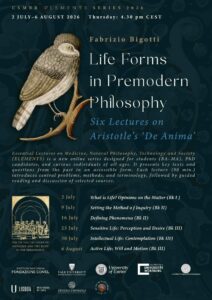


Life Forms in Premodern Philosophy
Elements Series
Life Forms in Premodern Philosophy
Six Lectures on Aristotle's "De Anima"
Online Series organised by
Fabrizio Bigotti
2 July — 6 August 2026
Few texts in history have enjoyed the centrality of Aristotle’s De Anima. The work presupposes and at the same time coordinates the entire structure of Aristotle’s inquiry on the living world and remained vital long after other parts of Aristotle’s natural philosophy ceased to command obedience in the academic world. This vitality was due also to the fact that Aristotle posed a question that few others in history have tried to address: what is life?
His answer stirs a middle ground between vitalism and materialism. Condensed into six lectures, these encounters will explore the nuances and complexities of Aristotle’s theory of the soul. Participants will read selected passages of Aristotle in English. Knowledge of Greek is not mandatory, but it would be an advantage as some technical terms are introduced and explained.
Registration Deadline
25 June 2026
Registration Fees
Regular: € 100
Members: € 40
ELEMENTS: Essential Lectures on Medicine, Natural Philosophy, Technology and Society, is a new series designed for students (BA–MA), PhD candidates, and curious individuals of all ages. It presents key texts and questions from the past in an accessible form. Each lecture (90 min.) introduces central problems, methods, and terminology, followed by guided reading and discussion of selected sources.
What is Life?
Opinions on the Matter
2 July 2026 — 4.30 pm CEST
Aristotle opens by asking what kind of knowledge the study of the soul is and why it matters. Since the soul is the principle of life, its investigation belongs to natural philosophy, yet it raises methodological difficulties common to all inquiries into essence. Is there a single method for defining what a thing is, and is the soul a substance, a quantity, or something else?
Further problems follow: is the principle of life material and divisible, are all souls the same, and should one begin from parts or from functions? The lecture explains why, for Aristotle, knowing what the soul is is necessary for explaining its attributes.
Textual References
Aristotle, De anima, I.1-2
402a1-405b30.
Setting the Method of Inquiry
9 July 2026 — 4.30 pm CEST
The inquiry turns to earlier accounts of the soul in order to establish the correct method of inquiry. Aristotle examines theories that define the soul through motion, perception, or elemental composition, showing that each captures a function of the living being but fails to account for its unity.
If the principle of life is identified with one activity or element, its individuality is lost, and its diverse operations remain unexplained. The lecture will examine how this requirement of unity determines both the object of inquiry and the method needed to investigate it.
Textual References
Aristotle, De anima, I. 3-5
405b31-411b30 (passim).
Defining Phenomena
16 July 2026 — 4.30 pm CEST
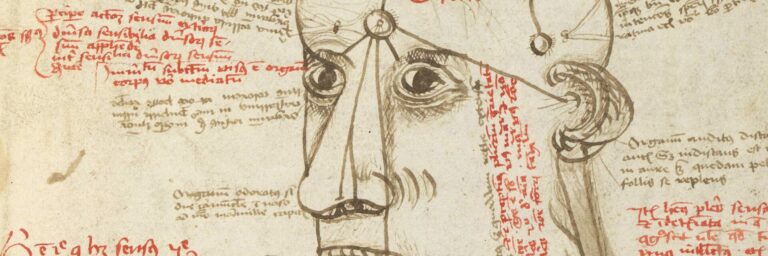
From preliminary questions, the inquiry moves to the definition of the principle of life. It is not a body but the form of a natural body that has life potentially. Aristotle further distinguishes levels of life, from nutrition to perception, and shows that these are not separate principles but capacities grounded in one.
The lecture examines how defining the principle of life as form allows Aristotle to explain life without reducing it to matter or separating it from the body.
Textual References
Aristotle, De anima, II.1-3
412a3-415a13 (passim)
Sensitive Life:
Perception and Desire
23 July 2026 — 4.30 pm CEST
Aristotle examines perception as a defining feature of sensitive life, arguing that it consists in the reception of form without matter. This allows him to distinguish perceiving from physical alteration while preserving the unity of the living being. From perception arise pleasure and pain, which ground desire and initiate movement.
Desire is thus not separate from perception but follows from it as its practical consequence. The lecture shows how perception and desire belong to a single principle of life and how their coordination explains animal behaviour without dividing the living into independent parts.
Textual References
Aristotle, De anima, II.12-III.1-2, 10
424a17-427a16; 433a9-433b10.
Intellectual Life: Contemplation
30 July 2026 — 4.30 pm CEST
The inquiry turns to intellectual life and distinguishes thinking from perception. Unlike the senses, the intellect does not receive forms through a bodily organ, which raises the question of how such a capacity belongs to the living being. Unlike perception, intellect is not limited to particular sensibles but is capable of universals. How does it grasp them?
A distinction emerges between potential and actual intellect, so that thinking becomes actual only in relation to its objects. This lecture will discuss how contemplation transcends corporeality without compromising the unity of the principle of life and how intellect relates to.
Textual References
Aristotle, De anima, III.3-6
427a17-430b31 (passim).
Active Life: Will and Motion
6 August 2026 — 4.30 pm CEST
Aristotle ends his treatise by explaining how living beings move. Motion does not arise from intellect alone but from desire, which directs action toward what appears good. Thinking presents its object, yet it does not by itself initiate movement. Desire, in response to perception or thought, provides the impulse to act.
The lecture shows how motion results from the coordination of cognition and desire within a single principle of life.
Textual References
Aristotle, De anima, III.6-7; 10-11
430a26-431b19; 433a9-434a21 (passim).
About the Organiser...
Fabrizio Bigotti is the Director of the CSMBR as well as Privatdozent (PD) and Lecturer at the University of Würzburg, where he teaches the history of medicine. His work examines the epistemology and operationalisation of medical and scientific knowledge from antiquity to the Enlightenment, with particular emphasis on medieval and early modern medicine and natural philosophy.