

Like Places, Like Peoples
FORMA FLUENS
Histories of the Microcosm
Like Places, Like People
The Intellectual Geography of
Hippocrates' «Airs, Waters, and Places»
Gabriele Torcoletti
The Hebrew University of Jerusalem
If it is true that the character of the mind and the passions of the heart are extremely different in the various climates, laws must be relative both to the difference of those passions and the difference of those characters.[1]
This famous opening, from Book XIV of Montesquieu’s The Spirit of the Laws (1748), links climate to collective character and political institutions. The idea had a much longer history. From its influential ancient formulation in the Hippocratic treatise Airs, Waters, Places (hereafter Airs), it shaped early modern developments in medical, natural-philosophical, and political writings, including travel literature and missionary accounts.[2]
Among Montesquieu’s more immediate predecessors was the Spanish physician Juan Huarte de San Juan, whose Examination of Men’s Wits (1575) reworked Hippocratic, Aristotelian, and Galenic theories of humoral temperament, relating differences in human aptitudes and dispositions to bodily constitution and environmental factors.[3]
Although Montesquieu does not mention Hippocrates in The Spirit of the Laws, extracts from Airs preserved among his papers at La Brède attest to his engagement with the treatise: he excerpted passages he found useful and combined them with a long tradition of reflection on climate and environment.[4] Half a century later, Adamantios Korais, a learned editor of Airs, cast Montesquieu as an ungrateful heir to Hippocrates: his glory–Korais argued–would not have suffered had he acknowledged the Greek physician whose “fertile principle” supplied the basis of his work.[5] After all, Montesquieu returns to questions already posed in the Hippocratic treatise: how do the places in which people live shape their bodies, dispositions, customs, and political institutions?
Airs approaches these questions from the standpoint of the ‘travelling doctor’ (περιοδευτής), a figure also encountered in works such as the Epidemics, who assesses unfamiliar places—often cities—by considering their exposure to winds and the sun, the quality of their waters and soil, and the course of the seasons, in order to determine how conducive they are to health. Chapters 1–11 set out criteria for predicting health, disease, and appropriate regimes; chapters 12–24 extend the inquiry to the bodies and characters of peoples, comparing Asia and Europe and examining the Macrocephali, Phasians, Scythians, and Sauromatae. The physician’s perspective here merges with that of the ethnographer: environment becomes a causal factor in assessing bodily, psychological, and political differentiation. This approach, which proved highly influential, rests on two ordering principles: analogy and polarity. Analogy links places, bodies, and collective characters; polarity orders qualities into opposing pairs. Together, these complementary modes of reasoning lend coherence to the treatise’s account of bodily processes and the formation of peoples and their political dispositions.
Polarity and Analogy in Ancient Philosophy and Medicine
Relations of polarity and analogy between objects, their properties, and their modes of interaction proved remarkably fruitful in ancient Greek thought as principles for organising and explaining reality. The observation of correspondences and differences through these broad schemata underlies many intellectual elaborations, from myth and philosophy to the natural sciences.[7] The Pythagorean table of opposites, reported by Aristotle, offers a paradigmatic example: already in the Presocratic period, heterogeneous aspects of reality were arranged in correlated pairs such as male and female, light and darkness, good and evil, right and left.[8] Analogy establishes relations among phenomena through resemblance, whereas polarity does so through contrasting characteristics; together, they offer interpretative and heuristic models for explaining phenomena, processes, and interactions.
In the Hippocratic Corpus, analogy and polarity recur as complementary principles for interpreting bodies and diseases and for guiding treatment. Polarity tends to prevail in therapy, where cure consists in correcting an imbalance through the application of an opposite quality. Analogy is more prominent in physiological and generative processes, where similarity functions as a principle of affinity, attraction, or assimilation.[9]
Polarity and Analogy as Causal Principles in «Airs»
Airs applies both schemes across a broad range of phenomena. Analogy links environmental qualities, bodily constitutions, and collective characters through a form of conditioning later described by human geography as “climatic determinism”. Polarity organises explanations of health and disease, vigour and weakness, and physical differences among peoples through opposing pairs (hot and cold, dry and moist, stability and change); in therapy, the application of a contrary quality restores the balance favourable to health.
Examples throughout Airs show how analogy structures causal explanation. The heat of the belly explains that of the bladder and the formation of stones; turbid, sediment-rich waters produce analogous deposits in the body; and hot, bilious milk promotes a similar process of combustion and condensation in the urine. The same logic accounts for the sweetness produced when the sun heats the lighter part of water, for the association between well-ordered seasons and health, and for the clear voices attributed to the inhabitants of east-facing cities supplied with clear waters.[11] Such correspondences are expressed through formulas of necessity (ἀνάγκη), likelihood (εἰκός), consequence (ἀκολουθεῖν/ἀκόλουθα), analogy (κατὰ τὸν αὐτὸν λόγον/ὁ αὐτὸς λόγος), and proximity (ἐγγύτης/ἐγγύτατα).[12]
From Environment to Peoples: Ethnography and Politics
In the second half of the Airs (chapters 12–24), analogy and polarity acquire ethnographic and political functions. Polarity structures the climatic contrast between Asia and Europe, which together comprise the author’s inhabited world, while analogy links their environments to corresponding physical, moral, and political traits. Europe’s variable climate is thus said to foster strength and resistance to monarchical rule, whereas Asia’s climatic uniformity produces softness, indolence, and acquiescence.[14]
From Airs onward, similar environmental explanations recur in the works of Plato and Aristotle, where climate, bodily constitution, and collective character help ground Hellenic superiority; Aristotle locates its basis in Greece’s intermediate position between Europe and Asia. In the direct or indirect reception of Airs, the same logic is applied more narrowly within the Greek world. Regional stereotypes—amplified, for example, by Aristophanes in his characterisation of the women assembled from different parts of Greece in the Lysistrata—receive climatic explanations.

Gabriele Torcoletti is….
In Posidonius’ account, preserved by Strabo, Athenian eloquence (the Athenians are φιλόλογοι) is attributed to the tempering of the air and seasons, and thus to physis, in contrast to the neighbouring Thebans and Spartans;[15] Cicero similarly contrasts the acuteness produced by Athens’ thin air with the stoutness and strength produced by Thebes’ denser atmosphere.[16]
The Hippocratic author formulates the same analogical principle almost programmatically: appearance and character follow the nature of the region in which people live.[17] Where the land is fertile (πίειρα), soft (μαλθακή), and well watered (εὔυδρος), its inhabitants are fleshy (σαρκώδεις), lacking visible joints (ἄναρθροι), moist (ὑγροί), and poorly resistant to fatigue (ἀταλαίπωροι); their disposition is indolent (τὸ ῥᾴθυμον) and drowsy (τὸ ὑπνηρόν), while in the arts they are coarse (παχεῖς), neither subtle (λεπτοί) nor sharp (ὀξεῖς).[18] Conversely, the inhabitants of bare (ψιλή), arid (ἄνυδρος), and rough (τρηχεία) regions are hard (σκληρούς), thin (ἰσχνούς), well articulated (διηρθρωμένους), tense (ἐντόνους), and hairy (δασέας); they are keen for work (τὸ ἐργαστικὸν ὀξύ), wakeful (τὸ ἄγρυπνον), stubborn (αὐθάδεας), and independent (ἰδιογνώμονας), sharing more in the wild (τοῦ ἀγρίου) than in the tame (τοῦ ἡμέρου), but also being sharper (ὀξυτέρους), more intelligent (συνετωτέρους), and better in warfare (τὰ πολέμια ἀμείνους).[19] Soil and the body thus form a parallel: soft land produces soft men, rough land rough men; moisture blurs the “articulations” of both terrain and body, while aridity makes them more defined and resistant.
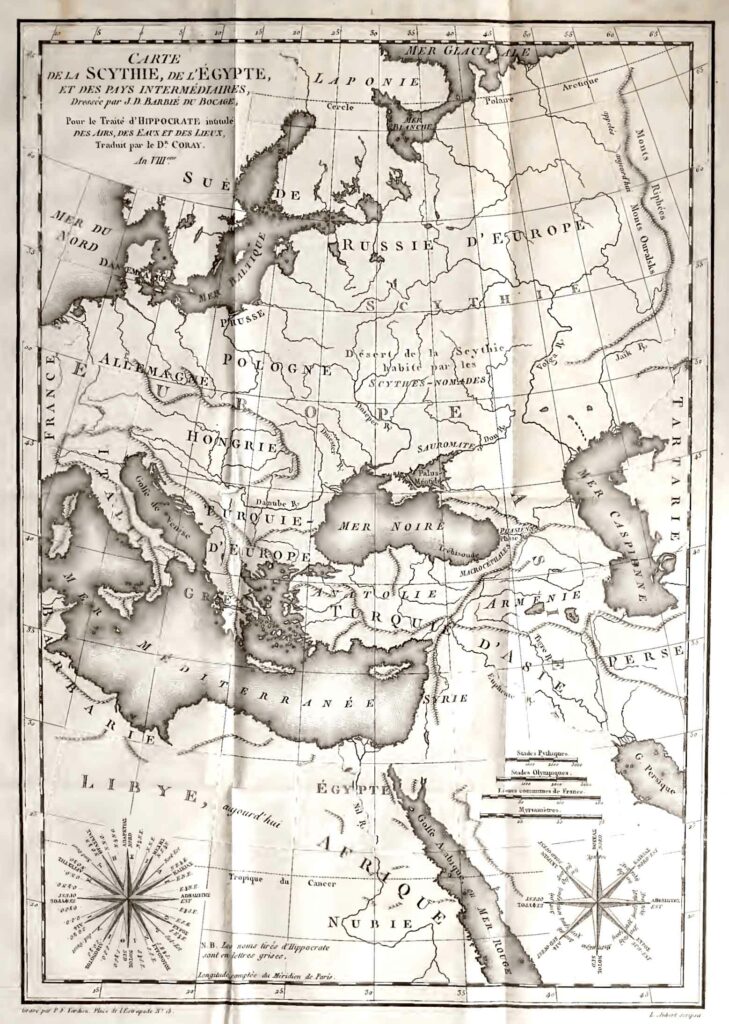
Figure 1. The world of Airs: a map of Scythia, Egypt, and the intervening regions, drawn by Jean-Denis Barbié du Bocage for Adamantios Korais’ edition of Hippocrates, Traité d’Hippocrate des Airs, des eaux et des lieux (Paris: Théophile Barrois, 1800).
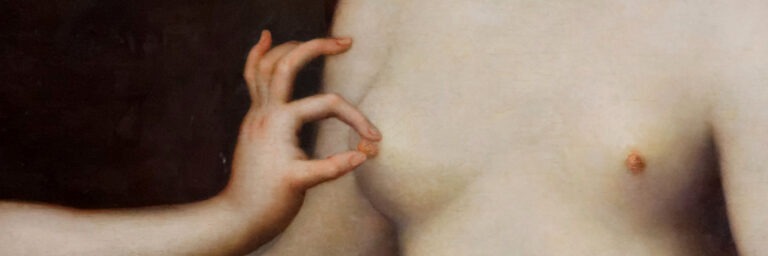
In the ethnographic section, the logic of polarity explains how one quality can counteract the bodily effects otherwise expected from a given constitution. The women of the Sauromatae, a Scythian people living near Lake Maeotis (the modern Sea of Azov), ride horses, shoot with the bow, hurl javelins from horseback, and marry only after killing three enemies. Their adoption of typically masculine practices is made possible by an early intervention on the body: in childhood, their mothers cauterise the right breast with a piece of heated bronze, preventing its growth and transferring its force to the shoulder and arm.[20] Physis, which would otherwise render the female body moist and soft, can thus be modified by a technique whose efficacy is explained through polarity: the fire of cauterisation consumes, dries, arrests the breast’s growth, and channels strength to the limb used for archery and javelin throwing.[21]
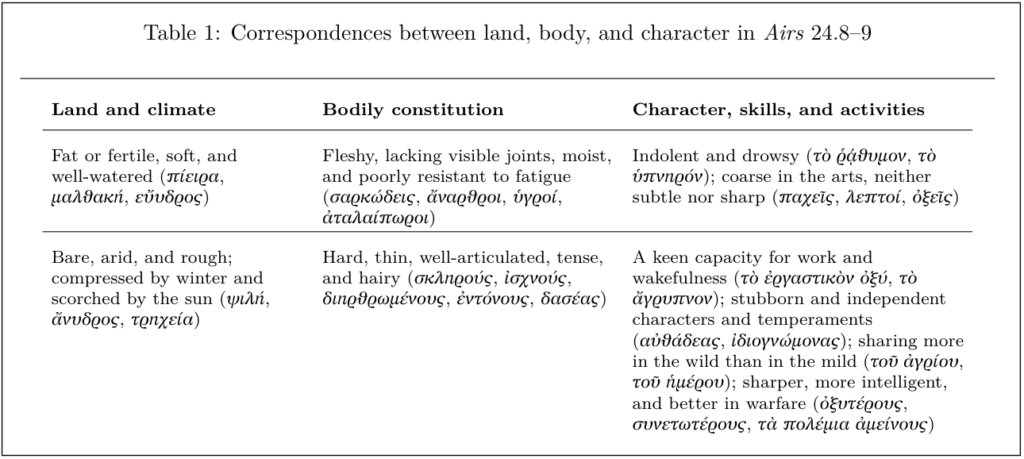
Table 1. Correspondences between land, body, and character in Airs 24.8-9.
Conclusion: The Longue Durée of a Hippocratic Idea
The novelty of Airs lies in its ability to bring ancient ethnographic judgements into a coherent aetiological framework linking environment, bodies, collective dispositions, and political life through analogy and polarity. This model enjoyed a long and varied afterlife: across different periods and intellectual contexts, readers adapted it to their own concerns. Montesquieu was only one member of the Europe savante to interpret the world through schemes connected, directly or indirectly, with Airs. Its reception begins in antiquity: Galen devoted an extensive commentary to the treatise, now preserved in Arabic, while its environmental approach reappears in Vitruvius’ discussion of urban planning and Libanius’ praise of Antioch.[22] In the early modern period, Girolamo Cardano published an extensive commentary in 1570; later, John Arbuthnot, Paul-Joseph Barthez, and Georges Cabanis drew directly on Airs in discussing climate’s influence on bodies, moral dispositions, and national character.[23] In 1839, Giovanni Capsoni, in his Italian translation of Airs, applied Hippocratic environmental theory to the Italian peninsula and to the geographical distribution of disease.
The questions posed by Airs remain recognisable today, although their terms have changed. Concern with the effects of human and political action on climate has not replaced the older question of how environmental conditions shape health and communities.[24] Rather, the relationship now appears reciprocal: societies transform their environments, which in turn shape bodies and collective life. Reconstructing the reception of Airs would make a significant contribution to the history of ideas by tracing the persistence and transformation of a model that explains human differences through the seemingly innocuous relationship between places, bodies, and character.