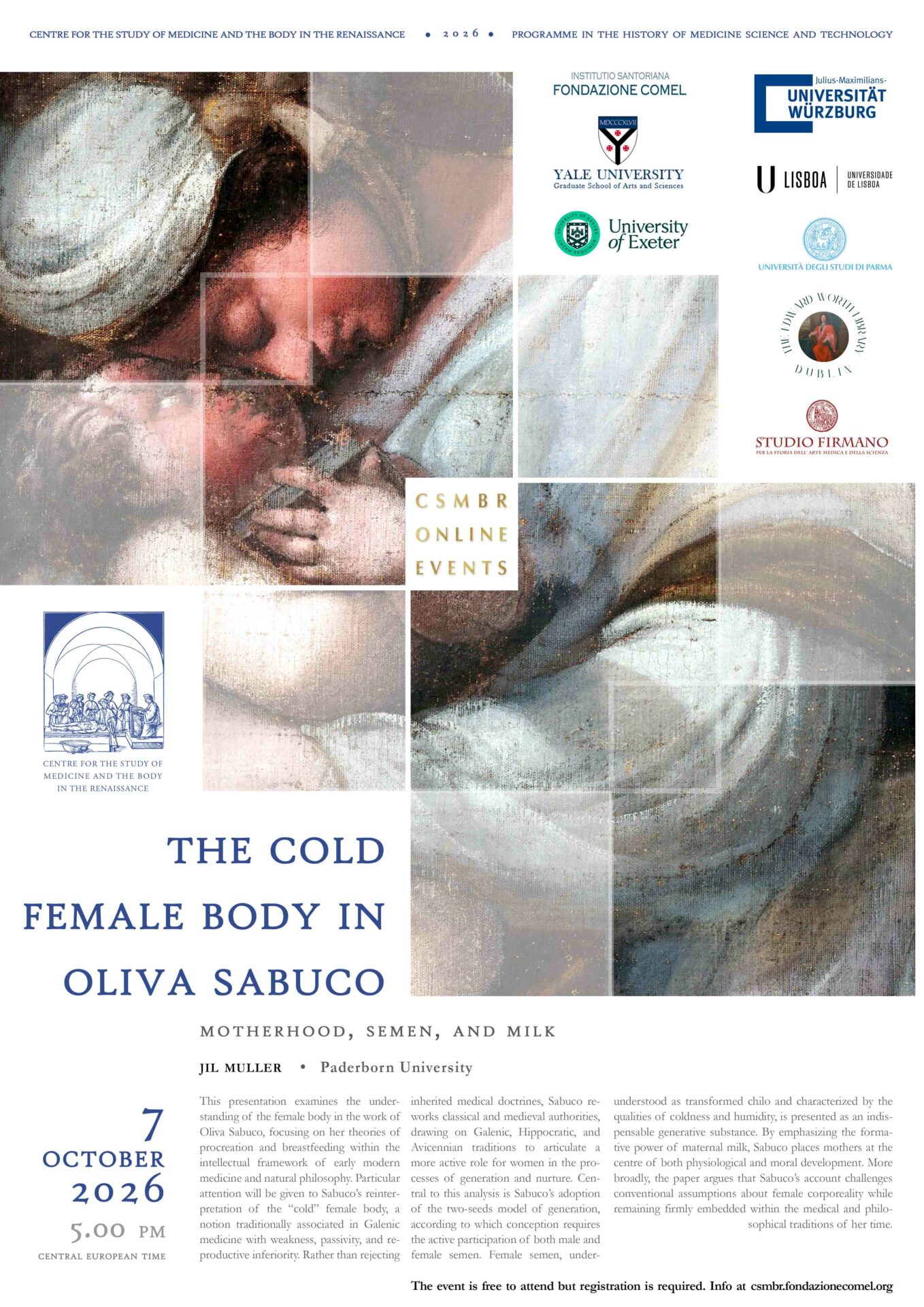


The Cold Female Body in Oliva Sabuco
The Cold Female Body
in Oliva Sabuco
Motherhood, Semen, and Milk
Jil Muller
7 October 2026 – 5 PM (CEST)
This presentation examines how the female body is understood in the work of Oliva Sabuco (1562-1646), focusing on her theories of procreation and breastfeeding within the intellectual framework of early modern medicine and natural philosophy. Particular attention will be given to Sabuco’s reinterpretation of the “cold” female body, a notion traditionally associated in Galenic medicine with weakness, passivity, and reproductive inferiority. Rather than rejecting inherited medical doctrines, Sabuco reworks classical and medieval authorities, drawing on Galenic, Hippocratic, and Avicennian traditions to articulate a more active role for women in the processes of generation and nurture.
Central to this analysis is Sabuco’s adoption of the two-seeds model of generation, according to which conception requires the active participation of both male and female semen. Female semen, understood as transformed chilo and characterized by the qualities of coldness and humidity, is presented as an indispensable generative substance.
In Sabuco’s account, coldness is not simply a mark of physiological deficiency but a necessary condition of fertility, balanced by the vital heat associated with blood and menstruation. Generation thus emerges from the dynamic equilibrium of complementary bodily qualities rather than from a hierarchical opposition between male and female bodies.
The presentation also explores Sabuco’s understanding of breastfeeding, in which breastmilk is conceived not merely as nourishment but as a substance that profoundly shapes the child’s physical constitution, temperament, and intellectual capacities. By emphasizing the formative power of maternal milk, Sabuco places mothers at the centre of both physiological and moral development. More broadly, the paper argues that Sabuco’s account challenges conventional assumptions about female corporeality while remaining firmly embedded within the medical and philosophical traditions of her time.
About the Speaker ...
Jil Muller is Deputy Head of the Center for the History of Women Philosophers and Scientists at the University of Paderborn, Germany, and Assistant Professor of philosophy.
Her research focuses, on the one hand, on the medical traditions of 16th- and 17th-century philosophers and scientists and their understanding of the body, mechanism and humourism, with a particular focus on women thinkers. She has published articles on Descartes, Montaigne, and Sabuco. She has recently edited the following volumes: Women and their Body (De Gruyter 2025), Automata, Cyborgs and Mutants: Eccentric Bodies from Humanism to Transhumanism (Palgrave Macmillan 2026), as well as Food, Plants, Remedies and Healing Practices: Women’s Ideas in the History of Medicine (Springer Nature 2026).